
Yadavindra Garden
As mentioned earlier, the Shish Mahal and Rang Mahal are two of the most striking structures in the garden. Additional charges may apply for special events or exhibitions held within the garden premises. After India gained independence in 1947, the garden came under the jurisdiction of the Haryana government. The British colonial period also saw efforts to maintain and restore the garden, further cementing its status as a heritage site. However, it was later revived by the rulers of the Patiala State, who recognized its historical and cultural significance. The garden has undergone several phases of restoration and renovation over the centuries, preserving its historical integrity while adapting to modern needs.
View all Places to Visit in Punjab
These celebrations bring the garden to life Yadavindra Gardens with music, colors, food, and traditional charm, making it a must-visit destination for locals and tourists alike. Pinjore Garden isn’t just a visual delight—it’s also a vibrant cultural hub that hosts a variety of meals, events, and festivals throughout the year. This magnificent 17th-century Mughal-style garden is a captivating destination that blends history, horticulture, and recreation.

Delight in the Events & Festivals of Pinjore Garden Chandigarh
During October when the Pinjore Heritage fest is held every year, is without any doubt a great if not the best time to visit the garden. Pinjore gardens are also called as Yadavindra Gardens and were constructed by the architect Nawab Fidai Khan in the 17th century. As visitors enter through the big entrance, the first terrace created in Mughal Style will be the first thing they would see. It is an example of the Mughal Gardens style, and was built by Patiala Dynasty Rulers.The garden is in the village of Pinjore lie 22 km from Chandigarh on the Ambala-Shimla road. Special festivals such as the Pinjore Baisakhi festival (spring festival) in April, Pinjore Mango Mela in July and Pinjore Heritage Festival in December are major annual celebrations at the gardens.

Pinjore Garden Travel Guide: Timings, Ticket Price, Distance & Attractions
- Later, the gardens came under the East Punjab Government after the partition of India and were renamed after Maharaja Yadavindra Singh of the former princely state of Patiala.
- The most important aspect of this festival is the Mango Exhibition where one can find a variety of Mangoes from all over India.
- Have you ever wondered what it would be like to visit a Mughal palace and garden?
- The design and layout of the garden take into account the climatic conditions, topography, and water availability of the region.
- Mughal Emperor Aurangzeb and his foster brother, Nawab Fidai Khan, who was a renowned architect during the era of the Emperor worked together to design the garden.
- A single water channel runs through the entire garden, falling down the chute at each level, creating mists.
- Come evening, the garden transforms into an illuminated spectacle.
The garden is built in a traditional Mughal style. He built the garden for his brother Aurangzeb who was the Mughal emperor at that time. It is a Mughal architectural garden that was built by Nawab Fidal Khan Koka who was a renowned architect of his time.
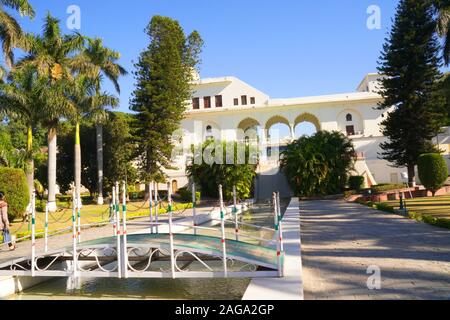
This garden of seven levels with its beautiful palaces was occupied by Fidai Khan and his harem for a few years only. After he established his kingdom in India, Babur created many gardens. Though Babur held Samarkand briefly, its garden and the concept of charbagh (a quadrilateral garden layout based on the four gardens of Paradise mentioned in the Koran) made a profound impression on him. They were renamed as the Yadavindra Gardens after Yadavindra Singh, the Maharaja of Patiala who ruled from 1938 to 1974 and who restored the garden to its former glory. My first visit to a Mughal garden was many decades ago. The main entrance opening into the first of seven terraces has been decorated in Rajasthani- Mughal Style, the first terrace is given the name of Shish Mahal- the palace of glass and lies adjacent to Hawa Mahal- the palace of air.
The palace also has a baradari (pavilion), with a dome and pillars, offering a panoramic view of the garden and the surrounding hills. The palace also has a hammam (bathhouse), with hot and cold water facilities. The terraces are connected by flights of steps and waterfalls, creating a harmonious and soothing effect. Yadvinder Garden is spread over an area of 100 acres, and consists of seven terraces, each with a distinct theme and style. It is also a venue for cultural events and festivals, such as the Baisakhi festival in April and the Mango festival in June. Visitors can enjoy illuminated fountains, cultural programs, and festive markets.