
Pinjore Gardens Yadavindra Gardens A Mughal Paradise in Haryana
There is no prior clarification of prices while taking the order, which leaves customers surprised at the billing counter.I strongly recommend visitors to ask for the price list before ordering anything. For reference, tea costs ₹90 and hot coffee costs ₹120.This pricing feels misleading, especially in a public tourist place where visitors naturally expect fair and transparent rates. The prices are not clearly visible, as the rate list is displayed on a small board placed high above the shops, which most visitors are likely to miss. It is one of the best places to visit in the area and offers a peaceful and scenic environment.However, the food experience inside the garden was disappointing.
- They were told that the air and water of Pinjore caused this menace of disease, and no one who lived there could escape it.
- The Jal Mahal at the centre of a water pool is well lit.
- The garden, originally known as the Persian Gardens, was built in the 17th century during the reign of Mughal emperor Aurangzeb by Fidai Khan Koka, Aurangzeb’s foster brother.
- There are water channels running right in the middle of the garden with fountains inside them.
- However, Fidai Khan’s summer retreat alarmed the neighbouring hill rajas “for they dreaded the coming of the Mughal Court, and feared still more to lose the use of the precious water which irrigated the surrounding country,” says Villiers-Stuart.
- Held annually, the Pinjore Heritage Festival is a grand cultural extravaganza organized by the Haryana Tourism Department.
- As the name suggests, this festival exhibits the best mangoes from every state in India.
Bryant Park Kodaikanal: Activities, Entry Fee, and More Crazy Hodophile 2026
The garden is beautiful year-round but is especially popular in the spring and winter months when the weather is pleasant, and flower shows are held. The garden is easily accessible from nearby cities like Panchkula and Kharar, making it a popular weekend getaway spot for locals and tourists alike. If you want to experience the best of history, architecture, and nature, then Pinjore Garden is the perfect place to visit. The garden is only 22 km from Chandigarh, and you can easily get a bus or hire a taxi to get there.
PINJORE BAISAKHI FESTIVAL
The next two levels lie dotted with lush green trees and sparkling fountains. The second level has arched doorways along with a painted palace called the Rang Mahal. Each Yadavindra Gardens of the seven terraces house several architectural wonders.
The text of her book is on the Gardenvisit website and the section which describes Pinjore Garden is quoted from in the below video. The garden was later revamped by the famous King Yadavindra Singh. He visited this place and was simply allured by its beauty. Save my name, email, and website in this browser for the next time I comment. Amrit Udyan is a famous and beautiful garden located inside the Rashtrapati Bhavan, the official residence of the…

Live folk arts and cultural programmes are also an integral event in the festival. The palace on next terrace is called the “Jal Mahal” having a square fountain bed and a platform to relax. Pinjore gardens came under the territory of King of Patiala during the 19th century. The garden was built in the foothills of the Great Himalayas as a summer retreat for Mughal emperor Aurangzeb. It is styled by the magnificent mughal architecture and later renovated by Jat Sikh Rulers of Patiala. Yadavindra Gardens which was previously known as Pinjore Garden is a 17th century garden situated in Pinjore in district Panchkula in Chandigarh Tricity.
Yadavindra Gardens in Pinjore is a bit of a historical heartbreak. Further down, the Jal Mahal (Palace of Water) sits uniquely submerged in a pool, surrounded by fountains, creating a cool, fortified oasis that perfectly balances structural strength with aesthetic pleasure. The highest terrace features the Shish Mahal (Palace of Glass) and Hawa Mahal, while the second hosts the arched Rang Mahal (Painted Palace). The layout follows the classic Charbagh pattern, featuring a central water channel representing the rivers of paradise. Renamed Yadavindra Gardens to honor Maharaja Yadavindra Singh of Patiala, this 17th century's marvel was originally commissioned by Nawab Fidai Khan, Emperor Aurangzeb's foster brother. There is no doubt that the garden itself is beautiful and well maintained.
The Yadavindra gardens has been laid in seven terraces, with the main gate of the garden opening into the highest first terrace, which has a palace built in Rajasthani–Mughal style. With its sprawling terraced lawns, cascading fountains, and ornate palaces, Yadavindra Gardens transports visitors to a world of serenity and splendor. Beautiful and clean garden with Mughal-style fountains, terraces, palace architecture. His preservation efforts ensured the survival of this rare heritage site, blending its Mughal origins with Sikh patronage.Distinct from traditional Mughal gardens where visitors ascend, Pinjore is unique for its seven descending terraces. Pinjore Garden built on the style of Shalimar Bagh, Srinagar, the garden has been laid in seven terraces, with the main gate of the garden opening into the highest first terrace, which has a palace built in Rajasthani–Mughal style.
- Best time to visit is in evening.
- She loved India and she loved its gardens.Unlike Chandigarh’s Capitol, Pinjore Gardens are very well adapted to the local vegetation, the local climate and local patterns of open space use.
- Spread over 100 acres, the garden reflects the grandeur of Mughal architecture with elements of Rajasthani and Persian styles.
- Visitors can enjoy illuminated fountains, cultural programs, and festive markets.
- The second terrace with arched doorways has the “Rang Mahal” (painted palace).
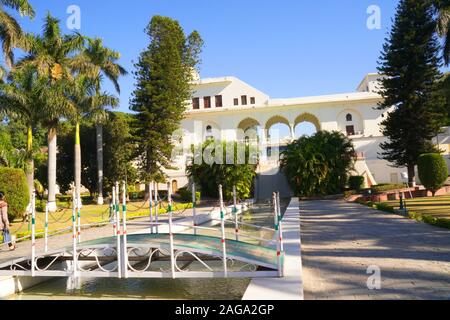
Pinjore Gardens is a budget-friendly and flexible destination that can be visited by anyone and anytime. The garden also uses natural elements such as sunlight, shade, and breeze to create different effects and moods in different terraces. The design and layout of the garden take into account the climatic conditions, topography, and water availability of the region.
The garden’s water features are fed by natural springs and are meticulously maintained to ensure a continuous flow. Water plays a central role in the design of Pinjore Garden, with numerous fountains and water channels enhancing its aesthetic appeal. The first terrace, which serves as the main entrance, sets the tone with its grand gateway and Mughal-style pavilions. The garden is spread across seven descending terraces, each offering a unique view and experience. The Charbagh design divides the garden into four quadrants with walkways and water channels intersecting at the center, creating a harmonious and balanced landscape. The garden is laid out in the traditional Charbagh (four-part) style, which is symbolic of the Islamic concept of paradise.